









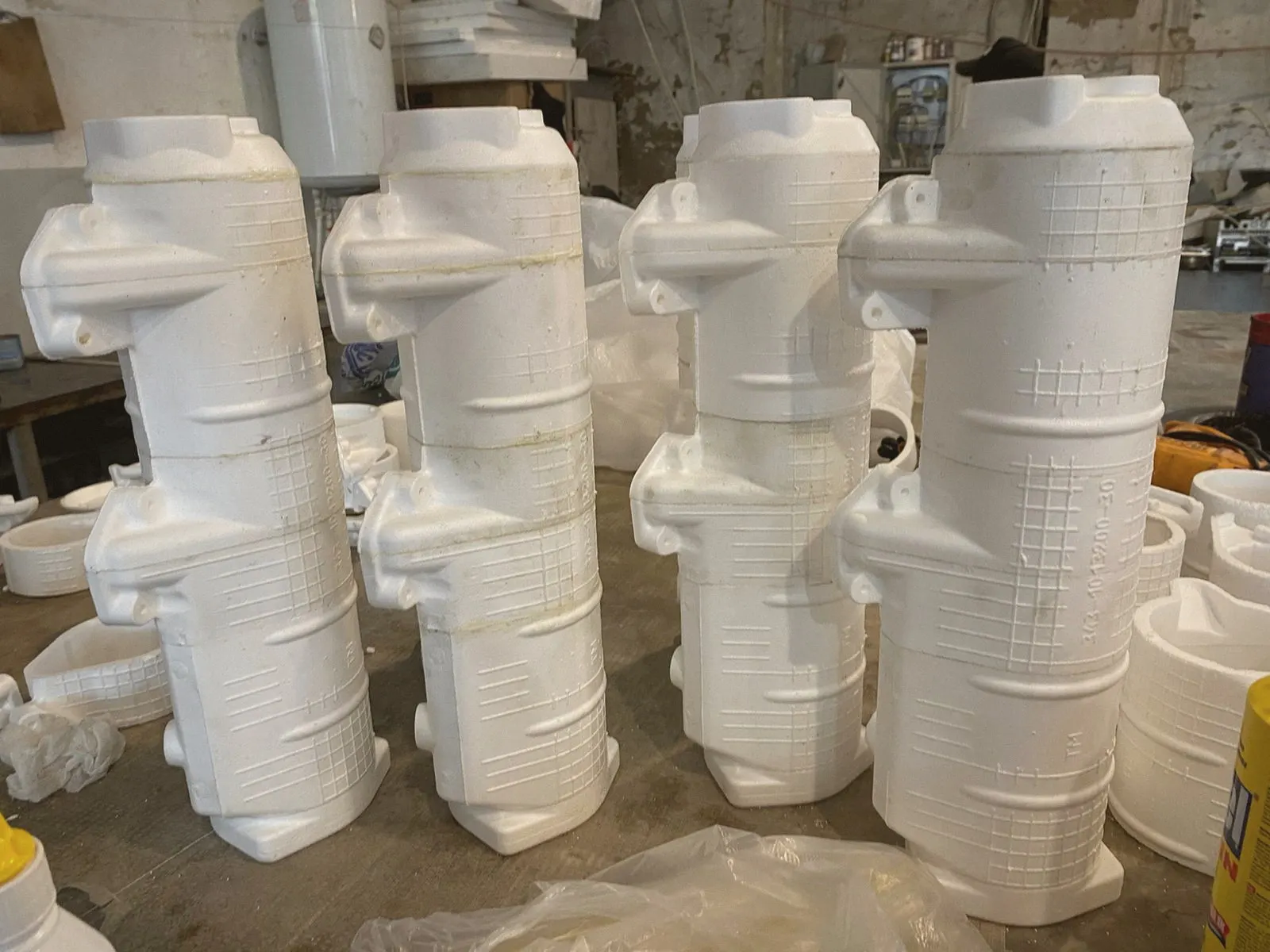
Modern Technologies supplies complete lost foam areas: a white shop for foam patterns built on MT-400/600/800 machines, monoblock flasks with a closed sand loop, the melting shop and operator training.
The lost foam process, step by step
- Tooling or pattern blank. For series production a die is made by a simplified route; for a one-off part the pattern is cut from a block of polystyrene on a CNC machine or a hot-wire cutter — including from a broken sample, with no drawings.
- Pre-expansion. Polystyrene beads are expanded to the required density. Residual blowing agent is checked with a pentane meter: the gas behavior during pouring depends directly on it.
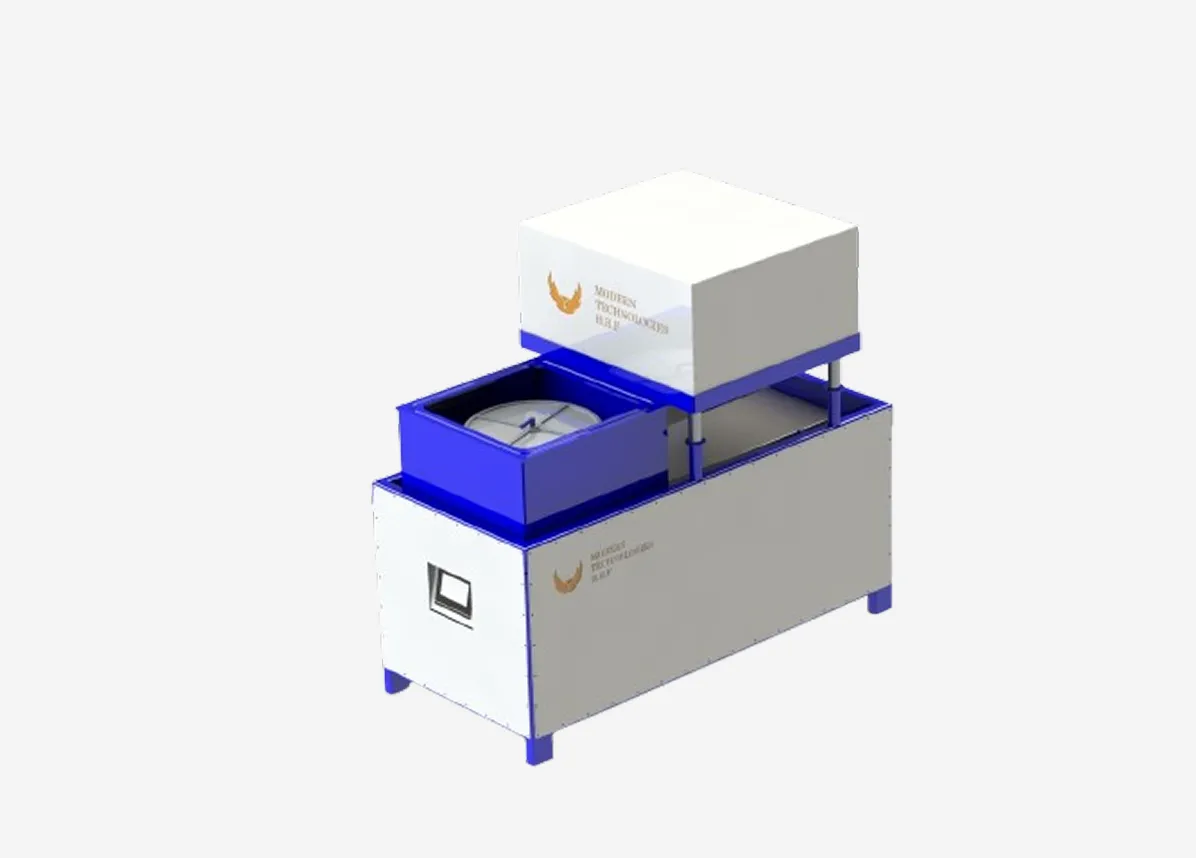
- Pattern molding. Beads are blown into the die and fused with steam on an MT-400, MT-600 or MT-800 semi-automatic machine, or on an AMT-600/AMT-800 automatic machine. In the Modern Technologies blowing unit the pressure is built in the hopper rather than in the gun: the polystyrene spreads evenly through the die, extra vent holes become unnecessary, and the die itself gets simpler and cheaper.
- Aging and drying. The pattern gives off moisture and residual blowing agent in a drying cabinet. An under-dried pattern is the single most common cause of gas defects.
- Cluster assembly. Patterns are glued to a gating system to produce several castings from one pour.
- Refractory coating. The cluster is dipped or flow-coated and dried. The coating holds the cavity wall once the pattern has vaporized and carries the decomposition products into the sand.
- Molding. The cluster is placed in a flask, buried in dry binder-free silica sand, compacted by vibration, and the flask is put under vacuum, which holds the sand around the pattern.
- Pouring. The melt vaporizes the pattern and takes its place. Vacuum is held until the casting solidifies.
- Shakeout and reclamation. The flask is tipped, the sand is cooled, screened and returned to circulation. Castings go to gate cut-off, tumbling and shot blasting, then to machining and painting.
Equipment for a lost foam area
The white shop — foam pattern production. The MT-400, MT-600 and MT-800 semi-automatic machines take dies of 400×400, 600×600 and 800×800 mm, occupy 1.5 × 1 × 2 m and deliver up to 150 patterns per hour. The MT-400 draws 4 kW and the MT-600 8 kW; the MT-600 has a built-in pre-expander function and handles blocks up to 500×500×500 mm. One operator is enough, and training takes 2–3 days. The AMT-600 and AMT-800 automatic machines — and versions built to custom die sizes from 600×600 mm — run 20–30 closings per minute at 18 kW and can also work in semi-automatic mode, which is the route to large runs and large parts.
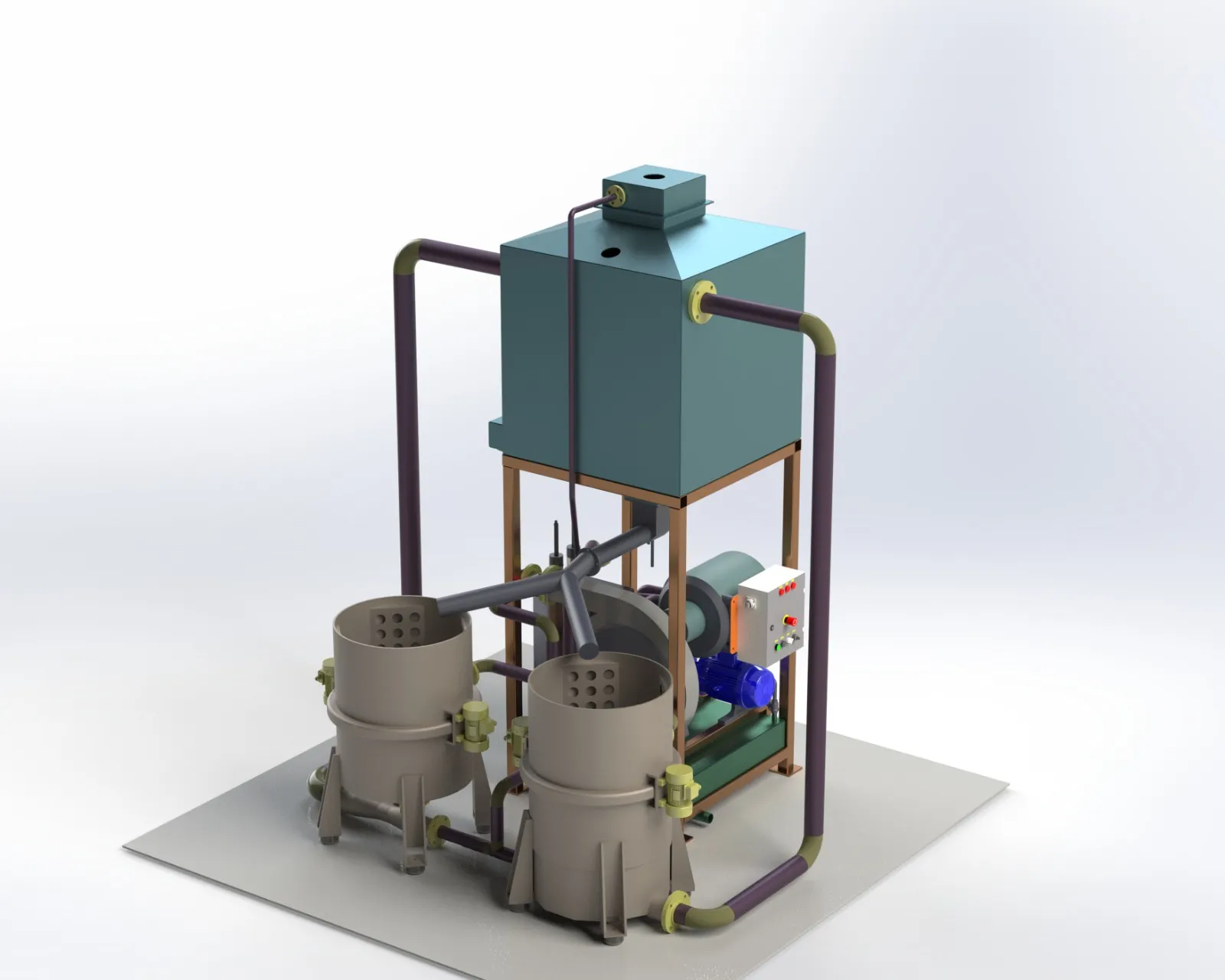
Monoblock flasks with a sand loop. A monoblock combines filling, vibration, vacuum, sand cooling and sand reclamation in one module. The range covers spiral flasks, single- and twin-station monoblocks and two-meter flasks. Each flask works independently of its neighbors, so production is expanded simply by adding modules, without stopping the line for installation.
Melting and finishing. Thyristor induction furnaces and resistance furnaces sized for the alloy and heat, a laboratory unit for metal analysis, a drying cabinet, a tumbling drum and a shot blasting machine. The automatic molding line pours metal mechanically under joystick and program control, so the operator never comes into contact with the melt — which removes both the injury risk and the typical errors of hand pouring.
What lost foam gives you
- Complex geometry in a single pour. No parting line and, as a rule, no cores — so no mismatch between mold halves, no core clearances and no flash along the parting line.
- Cheap tooling. Dies are built by a simplified route, and one-off parts need no die at all.
- Reverse engineering. A broken sample is enough to make a pattern and cast an exact copy, even where no drawings exist.
- A closed sand loop. Binder-free sand is cooled, screened and returned to work inside the monoblock.
- Smooth scaling. Start with one pattern machine and one flask; add capacity module by module as orders grow.
Limitations of lost foam
- The pattern is single-use: every casting consumes polystyrene and white-shop capacity.
- A separate pattern area is needed, with ventilation, heating and room for drying and storage.
- The gas regime is critical: pattern drying, residual pentane, coating quality and the gating system all have to be right.
- Foam patterns are bulky and fragile, so transport and storage need proper conditions.
If that list looks like an obstacle, compare lost foam with vacuum sealed molding: lost foam or V-process — which to choose.
Parts cast with lost foam
Brake drums and discs, valve and fitting bodies, brackets, bushings and housings, products for the mining, oil and construction industries, spares for special and agricultural machinery, railway and general construction castings. A separate and the most profitable niche is rare and discontinued parts: the price of such a casting is set by urgency and uniqueness rather than by the weight of metal.
Frequently asked questions
What is lost foam casting in plain terms?
The part is first made in foam: an accurate single-use copy of the future casting. The copy is painted with a refractory wash, buried in dry sand and poured with metal. The foam vaporizes ahead of the melt, the metal fills the space it leaves and solidifies in the shape of the part. The mold is never opened or assembled from halves — it is simply tipped out after cooling, and the sand goes back into circulation.
How does lost foam differ from investment casting?
In investment casting the pattern is made of a low-melting wax compound and is melted out of a ceramic shell before pouring, so the mold is empty by the time metal is poured and the shell has to be built and fired. In lost foam the polystyrene pattern stays in the mold and is vaporized by the melt itself, and the mold is dry binder-free sand with no ceramic at all. Lost foam is cheaper in tooling and materials and scales more easily to large parts; investment casting is traditionally more accurate on small, intricate parts.
What are the disadvantages of lost foam casting?
The pattern is single-use, so every casting consumes polystyrene and white-shop time. Series production needs a die for the foam pattern, which does not pay off on a single part — there the pattern has to be cut from a block. Vaporizing polystyrene calls for extraction and a properly designed gating system: if the drying schedule slips or residual pentane is too high, gas defects appear. Foam patterns are bulky and fragile, so they need storage conditions and careful handling.
Is a die needed for every part?
No. Series parts get a die, but it is made by a simplified route — without five-axis machining and without tight concentricity requirements — so each new die costs far less than a conventional one. For one-off parts and reverse engineering from a sample, the pattern is cut from a polystyrene block on a CNC machine or a hot-wire cutter, and no die is needed at all.
Which metals and which parts are cast with lost foam?
Iron, steel, bronze, aluminum and other non-ferrous alloys — the limit comes from the melting shop, not from the molding process. Modern Technologies plants cast brake drums and discs, valve and fitting bodies, brackets, bushings and housings, parts for the mining, oil and construction industries, and spares for special and agricultural machinery.
Get a quote
Send us a drawing or a photo of the part. We will work out the process, the plant configuration and the price.