









Railway Casting
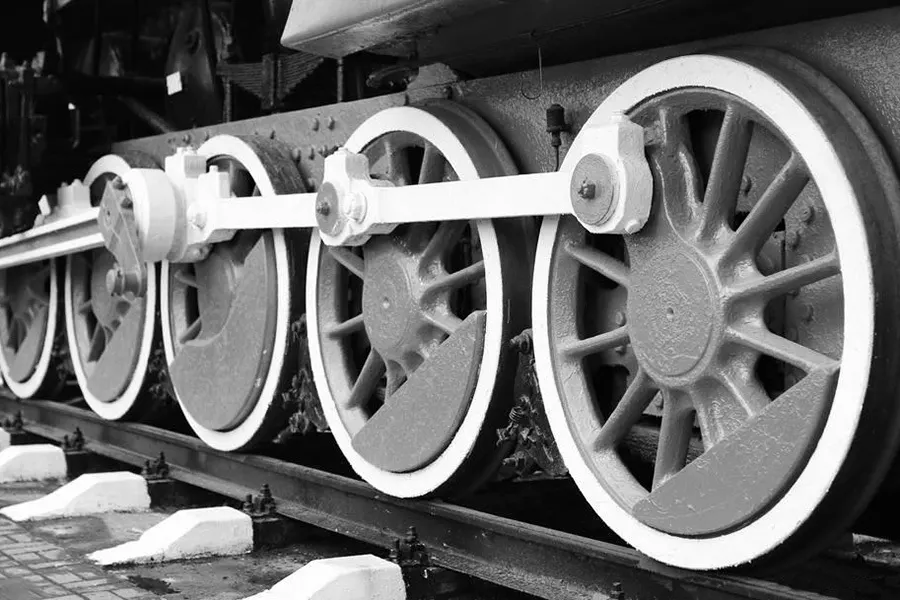
Railway casting is the production of high-strength, wear-resistant, and durable metal components that are critical to the safe and efficient operation of rail transport. These parts operate under extreme loads, impacts, vibration, and significant temperature swings. The reliability of the track, the rolling stock, and, as a result, the safety of transport all depend directly on their quality. Main purpose:
- Track superstructure elements: Frogs, frog points, wing rails, slide chairs, switch mechanism parts, clamps, base plates.
- Rolling stock parts: Bogie frame parts for freight and passenger cars, wheelsets (wheel centers), axle box housings, coupler assemblies (heads, shanks), brake shoes, brake linkage.
- Braking system components: Brake cylinder housings, compressor parts.
- Other elements: Counterweights, brackets, control mechanism parts. Key technical characteristics:
- Material: Mainly high-manganese steels (such as Hadfield steel) for parts subject to heavy wear and impact loads (frogs). Alloy steels (such as 20GL, 20FL grades) and ductile iron are used for frames and housings. Special cast irons are used for brake shoes. The choice of material is strictly governed by industry standards.
- Casting method: The most common are sand casting (for large parts), lost foam casting (LFC), and V-process (vacuum sealed molding), which provide high precision, material savings, and reduced machining. Chill casting may also be used for some parts.
- Size and shape: From relatively small clamps and base plates to massive bogie frames and complex switch frogs. Parts are characterized by complex geometry and high precision requirements.
- Surface quality: Requires strict control. Functional surfaces need minimal roughness and no defects. Most parts undergo significant machining after casting.
- Strength and durability: Critical parameters. Products must have exceptional impact toughness, fatigue resistance, abrasion resistance, and the ability to withstand dynamic and static loads many times their own weight.
- Standards compliance: Mandatory compliance with strict state and industry standards (GOST, technical specifications, safety norms) and certification of products for use on the railway. Production capabilities: Type of production: Modern Technologies mini-plant Casting method:
- Lost foam casting (LFC) - makes it possible to produce complex parts with high precision and minimal machining allowance, reducing subsequent machining costs. Effective for series and small-batch production of complex components.
- V-process (vacuum sealed molding) - a modern, resource-saving technology that delivers excellent surface quality, high dimensional accuracy, and fewer casting defects, which is critical for demanding railway parts. Floor area: From 500 m² Output: From 900 tonnes of finished products a year. Wholesale price in Kazakhstan - from $2.4/kg and up Margin - 20-45% (depends on part complexity, steel/iron grade, order volume, and finishing requirements). Kazakhstan market price (approximate benchmarks): By kilogram:
- Cast-iron parts (for example, brake shoes, brackets): from $2.4/kg to $5.6/kg.
- High-manganese steel (for example, frogs): from $6/kg to $12/kg.
- Alloy steels for bogie frames and couplers: from $5/kg to $10/kg. By unit price (finished products, examples):
- Brake shoe (cast iron): from $12/pc to $36/pc.
- Coupler head (steel): from $160/pc to $500/pc.
- Frog core (high-manganese steel): from $600/pc to $3,000/pc (depending on type and size). Price depends significantly on the metal grade used, geometric complexity, and weight of the item, the order batch size, as well as machining, heat treatment, and non-destructive testing requirements.
Get a quote
Send us a drawing or a photo of the part. We will work out the process, the plant configuration and the price.